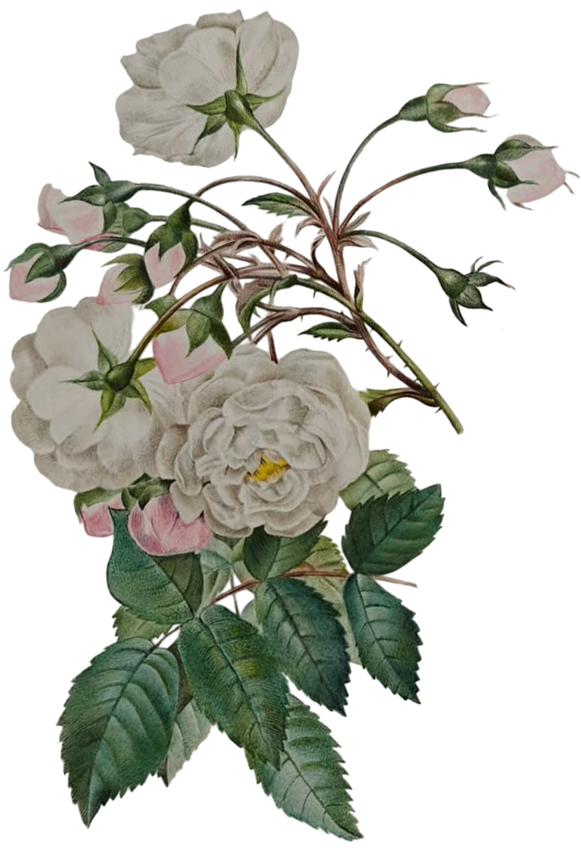
Opaque watercolours and gold on faux ivory
Size: 8” x 10”
Year 2011 to 2020
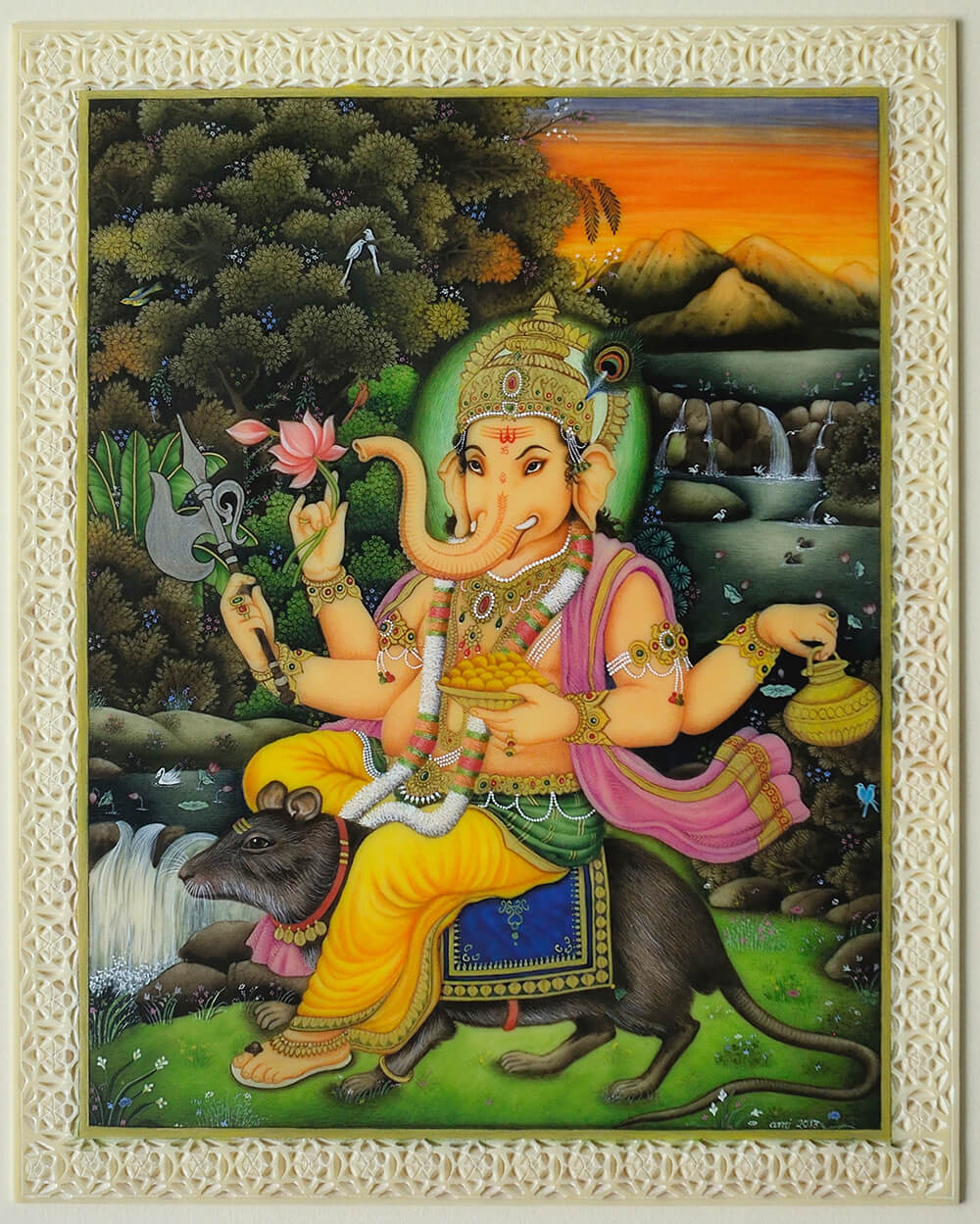
Ganesha: Lord of Thresholds
Seated at gates and entrances, Ganesha is known as the Lord of Thresholds, a guardian and keeper of sacred space. Ganesha is generally represented with one tusk and tooth. Elephant-headed, with a human-like or celestial form, his appearance is deeply suffused with metaphysical symbolism. The elephant is a symbol of the virtue and wisdom which Ganesha embodies.
He is often shown riding a mouse which can be understood to symbolize the crafty ego and it’s frailties. Accepting the mouse as his vehicle, he shows how the mischievous nature of the ego can be conquered by the vast awakened nature of spiritual consciousness. Another beautiful interpretation is to see the weight of Ganesh as symbolizing divine grace, the mouse being the human soul receiving and acting as a vehicle of this mercy.
His very body seems a paradox, a combination of human and divine elements which show him to be radically free and unconditioned and, at the same time, in touch with nature and the world.
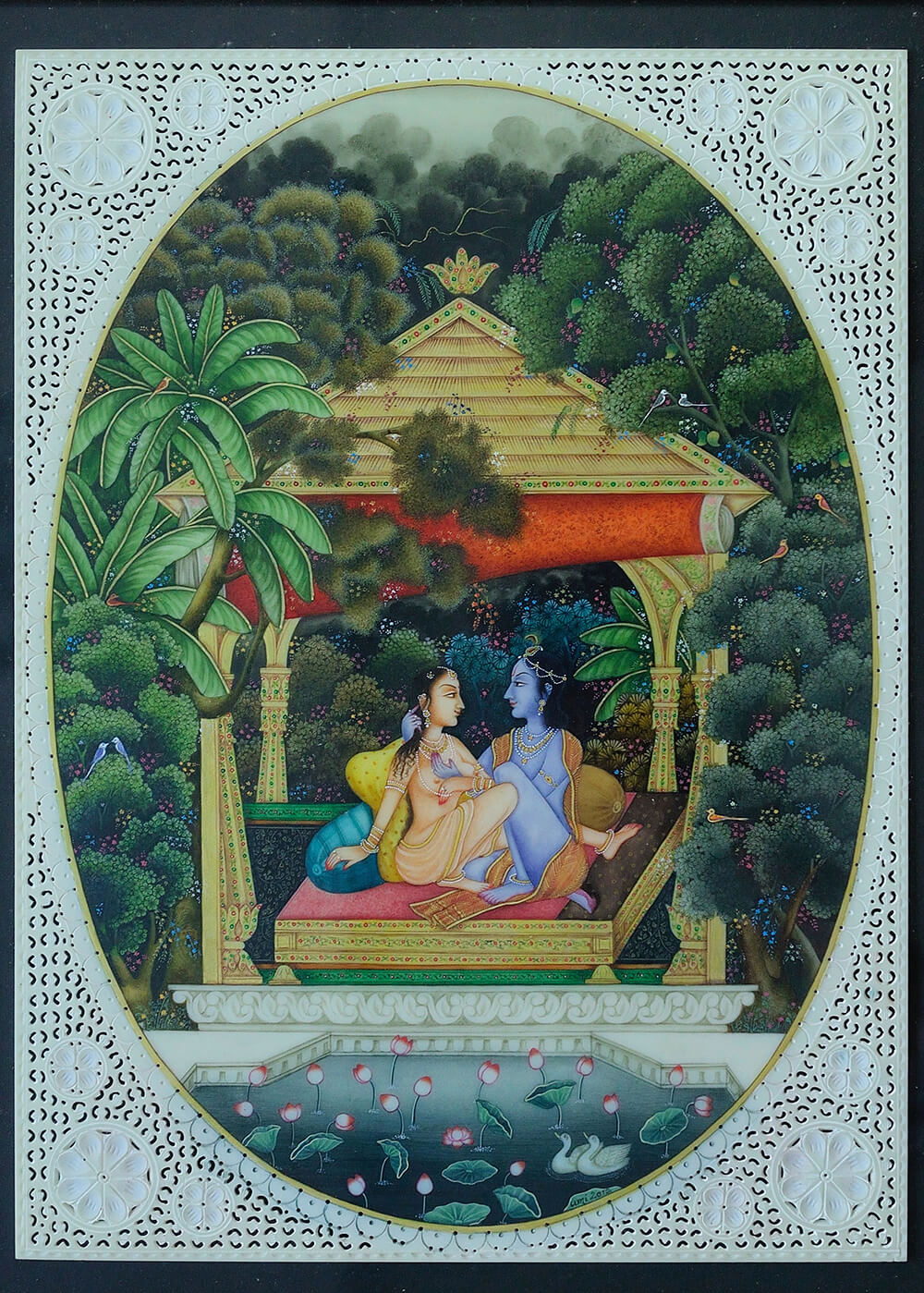
The Pavilion Of Love
Opaque watercolour and gold on faux ivory
Size: 9” x 12”
This painting is all about love and captures a moment of great tenderness while imparting to it at the same time an air of universality, of being beyond time.
The reticence with which this is stated is remarkable. The lovers are completely naked, with not a stitch of clothing on them, and yet there is nothing carnal about the scene, no suggestion of lust.
As Krishna holds Radha in a light embrace, the right hand supporting her head from the back while caressing her flowing hair, with his left he reaches out to touch her breasts. And as he does that, Radha extends her right arm to the cushions behind her as if to steady herself for the quiet surges of passion.The way one leg of each of them, raised and bent at the knee, is disposed keeps one from seeing any more of their nudity. The eyes of the lovers are locked, but one can be certain that not a word is being spoken.
The setting is almost other-worldly. A Golden pavilion open on all sides –pillars studded with precious stones, a gold-and-vermillion cloth screen jauntily tied up and raised, the roof almost completely covered with flowering creepers and branches of flanking trees—is set in the open. The season portrayed is that of the rains when irresistible longings rise in lovers’ hearts and the sights of the season are meant to be delighted in to the full.
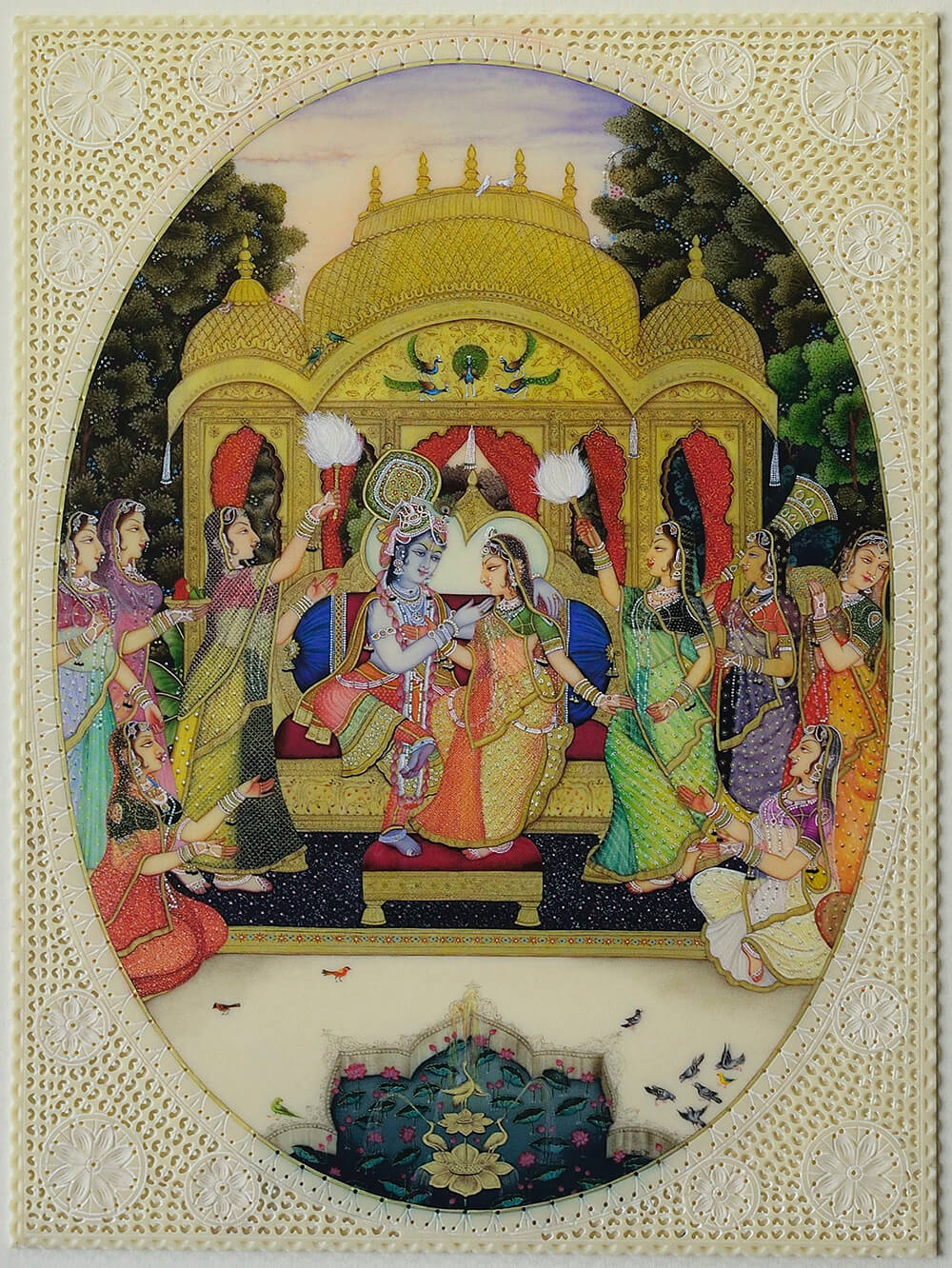
The Divine Couple In A Golden Bangalo
Opaque watercolour and gold on faux ivory
Size: 9” x 12”
The love legend of Radha and Krishna is an inexhaustible source for the artists inclined to depict various romantic moods and situations and in the process, achieve a synthesis of spirituality and sensuality. Krishna is the protector of love and divine joy, usually depicted as a mischievous boy, a flute playing shepherd or a princely youth. His divine love is his childhood friend Radha, who is the incarnate of the goddess Lakshmi. Together they represent the essence of love, devotion and aesthetics.
Radha and Krishna are seated on a throne in a Golden Bangalo. Krishna’s contemporary gopi friends assist them in their secret rendezvous. These gopis serve palatable meals to the divine couple and afterward relish tasting the remnants left by them. These gopis carefully guard the secret of Radha’s and Krishna’s confidential pastimes together. They please Radha and Krishna by expertly singing, dancing and playing instrumental music.
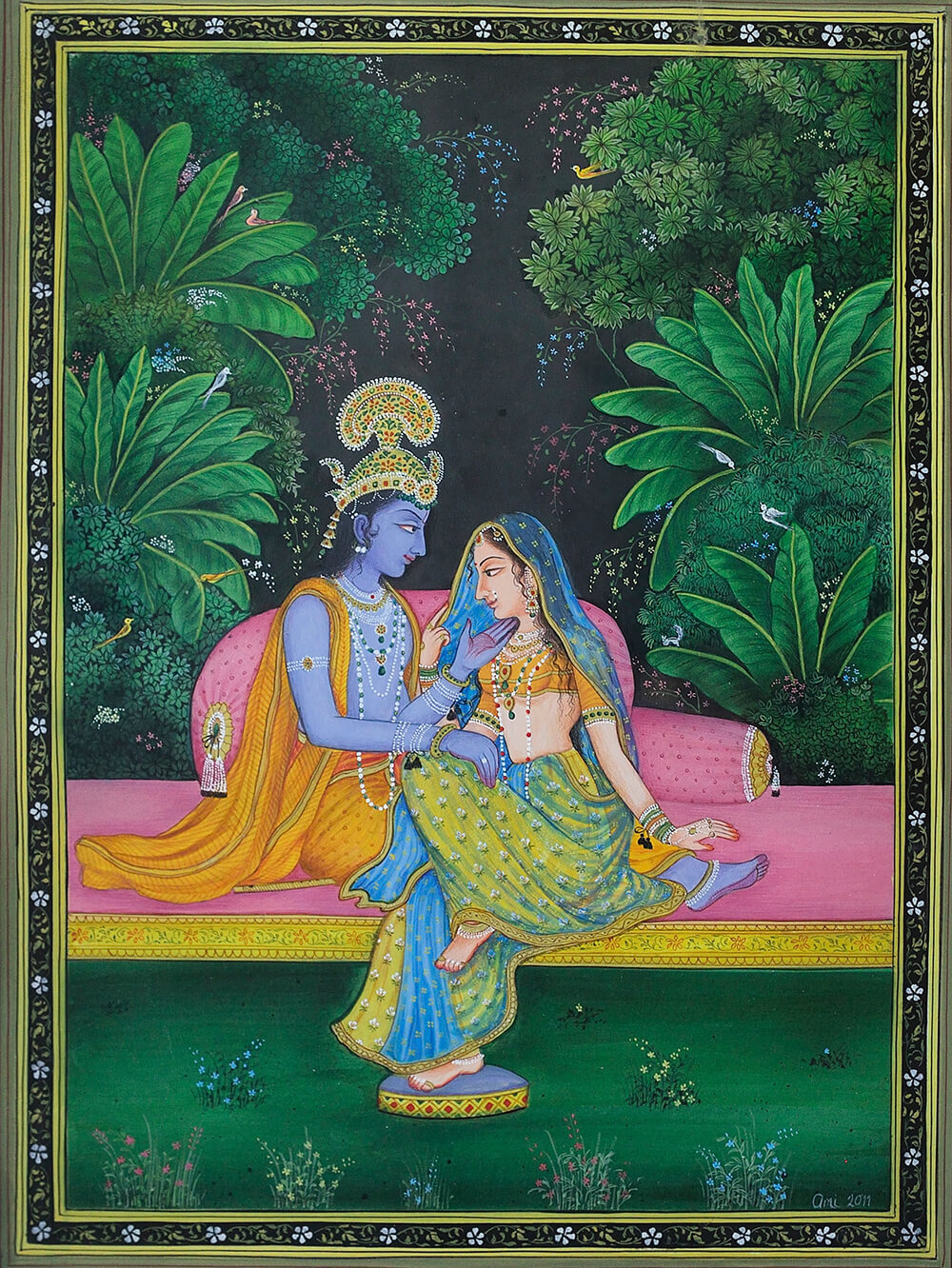
Secret Rendezvous of Radha and Krishna
Opaque watercolours on paper
Size: 7.5” x 10”
Radha and Krishna are engaged in a secret rendezvous in the dense forests of Vrindavan.The atmosphere of the forest adds to the romance. Radha appears really coy and very aware of Krishna’s physical proximity. She holds her veil in one hand in a feigned attempt to hide her face.
It seems that the birds around are also in love. The flowers from the trees around seem to come lower in order to seek their blessing.